Showing posts with label FILM AND REAL LIFE. Show all posts

Friday, April 14, 2017

Marine Le Pen and Holocaust in France

Marine Le Pen and Holocaust in France


มารีน เลอ แปนปฏิเสธว่ารัฐบาลฝรั่งเศสไม่มีส่วนรู้เห็นในการจับชาวยิวไปฆ่าในช่วงสงครามโลกครั้งที่สอง โดยเฉพาะในเหตุการณ์ที่ตำรวจฝรั่งเศสจับชาวยิว 13,000 คนในกรุงปารีสไปไว้ที่สนามกีฬาเวโลโดรม ก่อนจะส่งตัวไปเข้าค่ายเอาช์วิตซ์ในเดือนก.ค. 1942 โดยนางเลอ แปนบอกว่า เธอถือว่ารัฐบาลฝรั่งเศสที่แท้จริงในตอนนั้นเป็นรัฐบาลพลัดถิ่นที่อยู่ที่กรุงลอนดอน
http://www.reuters.com/article/us-france-election-le-pen-idUSKBN17C0V8

สำหรับคนที่สนใจเหตุการณ์นี้ สามารถดูได้จากหนังเรื่อง

1.BLACK THURSDAY (1974, Michel Mitrani)
2.MR.KLEIN (1976, Joseph Losey)
3.TWO WOMEN IN PARIS (2000, Caroline Huppert)

1932 DEMOCRATIC REVOLUTION PLAQUE DISAPPEARED

1932 DEMOCRATIC REVOLUTION PLAQUE DISAPPEARED
http://prachatai.org/english/node/7072

ข่าววันนี้ทำให้นึกถึงหนังเรื่อง ON PROGRESS (2013, Abhichon Rattanabhayon) ด้วย ที่เนื้อหาส่วนหนึ่งพูดถึงความพยายามทำลายล้างอาคารต่างๆของคณะราษฎร ที่รวมถึงอาคารศาลฎีกา

อันนี้เป็นข้อมูลจากประชาไท
“กลุ่มอาคารศาลฎีกา โดยเดิมทีนั้น เป็นที่ทำการศาลอุทธรณ์ ศาลอาญา และศาลฎีกา ออกแบบโดยพระสาโรชนิมมานก์ ซึ่งอาคารนั้นเป็นสถาปัตยกรรมสมัยใหม่(10) ทำพิธีเปิดเมื่อ วันที่ 24 มิถุนายน พ.ศ.2486 ซึ่งวันเปิดนั้นมีความเชื่อมโยงกับวันที่ก่อการเปลี่ยนแปลงการปกครอง พ.ศ.2475 อย่างหลีกเลี่ยงไม่ได้ และเสา 6 ต้น ที่อาคารศาลฎีกานั้นแสดงให้เห็นถึงสัญลักษณ์ตามหลัก 6 ประการของคณะราษฎร และ มีอาคารที่เป็นที่ระลึกที่ได้เอกราชทางศาลหลังแก้สนธิสัญญาเบาริ่ง(11)
สมัยที่คณะราษฎรยังมีอำนาจนั้นมีการสร้างโครงการขนาดใหญ่ เพื่อตอกย้ำความก้าวหน้าที่ได้ระบอบประชาธิปไตย อย่างเช่น อนุสาวรียประชาธิไตย โรงแรมรัตนโกสินทร์ โรงแรมสุริยานนท์ ศาลาเฉลิมไทย ห้างไทยนิยม ตึกโดมมหาวิทยาลัยธรรมศาสตร์ อนุสาวรีย์พิทักษ์รัฐธรรมนูญ(อนุสาวรีย์ปราบกบฎบวรเดช)

แต่การลดทอนทางประวัติศาสตร์ก็ปรากฎขึ้น เช่น อนุสาวรีย์พิทักษ์รัฐธรรมนูญ บัดนี้ ทุกคนเข้าใจว่าเป็นอนุสาวรีย์หลักสี่โดยน้อยคนนักที่จะรู้ภูมิหลัง การทุบศาลาเฉลิมไทย(12)ที่ริอาจเทียบรัศมีศาลาเฉลิมกรุง บัดนี้กลายเป็นลานมหาเจษฎาบดินทร์ โดยเป็นที่ทราบกันดีว่า หลังจากทุบศาลาเฉลิมไทยก็เป็นลานที่ไม่ได้เกิดประโยชน์ใดๆและก็มิได้มีปฏิสัมพันธ์กับประชาชน ซึ่งแตกต่างเมื่อครั้งยังมีศาลาเฉลิมไทยและเหยื่อรายล่าสุดที่เป็นประวัติศาสตร์ที่ยึดโยงคณะราษฎร คือ อาคารชุดศาลฎีกา”

Friday, May 04, 2012

This case should be made into a movie.

May 3 (Reuters) - A U.S. microbiologist charged under an anti-terrorism law for attempting to poison her husband's mistress lost a bid to overturn her conviction on Thursday.
Carol Anne Bond had argued that the U.S. federal chemical weapons act, which makes it a crime to acquire or use any chemical weapon, was meant to target terrorist activity, not the crimes of a spurned lover.
A Philadelphia-based federal court rejected Bond's appeal, ruling that the government was justified in applying the law, even if it seemed a questionable move.
Judge Marjorie Rendell called the government decision to prosecute under the law "troubling," but said similar prosecutions often occurred in drug cases.
Bond, who worked at chemical company Rohm and Haas in Pennsylvania, was sentenced to six years in prison in 2008 after pleading guilty to trying to poison her husband's mistress with chemicals stolen from her employer.
She admitted sprinkling lethal arsenic-based compounds on the woman's mailbox, car door handles and the doorknob of her house. The mistress noticed the chemicals and was not harmed, apart from a burn to her thumb.
In 2011, the U.S. Supreme Court reversed an earlier decision by the Philadelphia court rejecting Bond's right to appeal.
Bond's lawyer was not immediately available for comment.

Tuesday, July 26, 2011

FILM AND REAL LIFE 9: A FEW GOOD MEN AND REDEMPTION

This tragic news about the brutality of Thai military reminds me of the films A FEW GOOD MEN (1992, Rob Reiner, A+) and REDEMPTION (2008, Sabrina Wulff, A++++++++++). I think the story in this news should be adapted into a Thai film, or at least a Thai documentary, so that people will not forget this tragic incident.

The news below is copied from Bangkok Post:
http://www.bangkokpost.com/print/248526/

When Songkhla native Wichen Puaksom left home to join the military in May, he was healthy, energetic, and eager to serve the nation.

A month later, the lifeless, bruise-covered body of the 26-year-old masters graduate was back in his home town to be cremated.

Wichen did not die in the service of the country he loved, but was beaten to death at his military camp by about a dozen lowranked and mid-ranked soldiers as punishment for disobeying orders and absconding from camp. Wichen’s disfigured face and injured body moved family members to the conviction that justice must be done for Wichen.
They started submitting petition letters to state agencies seeking an explanation for what happened.

The Narathiwat Ratchanakarin army camp, where he served time as a conscript, sent soldiers to his funeral, asking if it could cover his coffin with the national flag, but the family refused.

His family says the flag draped over Wichen’s coffin cannot disguise the atrocity which he suffered at the hands of the state. They say Wichen was beaten to death in a form of institutionalised torture condoned by army top brass to drum "discipline" into errant troops.

Wichen, who reported for conscription after leaving the monkhood, might have found life as a conscript unbearable, so fled the Narathiwat Ratchanakarin military camp where he was being trained.

When soldiers from the camp caught up with him, they beat him as punishment, in a form of military correctional training known as "repairing".

The Human Rights Commission (NHRC), which investigated his death at the request of Wichen’s family, says he was beaten over the course of 2 days, and denied medical treatment by the army when fighting for his life.

Wichen died in Narathiwat Provincial Hospital’s intensive care unit on June 5 of multiple injuries, including acute renal failure, and severe muscle injury.

The commission believes he was subjected to two days of beating, starting on June 1.

His mother, Prathuang Puaksom, a farmer and vendor in Songkhla province, is struggling to come to terms with the loss. "I could not believe that it was him, as I barely recognised him in hospital. I don't know why he had to suffer so much," she said.

Her plucky niece, student Narisarawan Kaewnopparat, has taken up the fight for justice on the family's behalf.

"We want the military to acknowledge publicly what it has done," said Narisarawan, a student at Thammasat University, adding that her grandmother does not want this cruelty to happen to any family in the future.

She recalls Wichen, her mother's youngest brother, as a quietly spoken, unassuming man who did not pick fights with anyone.

"Four people in Songkhla who attended his funeral told us that their sons died in the same way.

"They did not dare complain. They asked, ‘How can poor farmers such as ourselves fight the army? We have no power'," she said.

She has petitioned the army, the government, and Privy Council president Gen Prem Tinasolanonda, a former army head who is also a Songkhla native.

Her advocacy met with partial success, when the Fourth Army Region set up an inquiry into the attack. In its finding, it says it will discipline the officers involved.

"My grandmother is in such pain. She was looking forward to relying on my uncle, as he is the youngest son," Narisarawan said.

"She was proud of him as he was a good, humble person and excelled at study as well."

Wichen reported for military service on May 1, and made his first escape from the camp on May 9.

He fled a second time on May 29, but, without money, was forced to take shelter nearby.

The army caught him, and started to work on him with a regime of "disciplinary improvement" or "repairing" on June 1.

Eyewitnesses told the military committee that the punishment started at 11.50am on June 1, and lasted until 1 am of June 2.

He suffered extensive injuries during the ordeal but was not sent to nearby Chor Ai-Rong district hospital in Narathiwat until June 3.
A doctor told the commission hearing that the army would not allow Wichen to be admitted.

Officers merely wanted his injuries treated, after which they would take him back to camp to be cared for by an army physician. However, the hospital doctor insisted he be admitted, as his condition was serious.
The commission sub-committee investigating the death learned later that the doctor in-charge at the camp was on leave.

Officers relented and allowed Wichen to be admitted after lengthy negotiations with the doctor.

Chor Ai-rong hospital referred him to Narathiwat provincial hospital, as he needed specialised equipment to help his kidneys.

At the provincial hospital, Wichen was admitted to intensive care, his condition severe. No one told his family.

His mother and brother learned that he had been admitted only by accident, after a friend happened to visit the hospital on June 4.
It was evening. They were unable to travel to Narathiwat immediately, for fear of their safety in the dark.

Nor could they afford a car. Wichen's mother and brother travelled by bus to the hospital the next day, arriving about 1pm.

By then, Wichen was too ill to speak. "His eyes were still open but he could no longer speak, but we learned from well-wishers later what happened — how many people tortured him, and their ranks," said Manas, his elder brother.

The family is amazed that the army would resort to such vicious conduct, just to ensure a soldier obeys orders.

"Wichen entered the military after serving in the monkhood for eight years. He might not have been as strong as people who had been working outside the monkhood," said Mr Manas.

Wichen recently finished a master's degree at Thammasat University, and earlier graduated with a bachelor's degree from Maha Chula Ratchawittayalai (Buddhist) University with first class honours.
On July 11, the commission asked the army to send officers in charge at the camp to testify.

Angkhana Neelapaijit, a member of the NHRC's sub-committee investigating the death, said she could not believe what went on. "I could not believe that this is how they punish someone who fails to follow orders," she said.

When Wichen's body returned home on June 6, his family said it was covered in bruises. Even his private parts were swollen —"the size of a coconut", said Ms Angkhana, a former nurse.

Twenty-seven witnesses testified before the Fourth Army Region's investigation, which like its NHRC counterpart, was held behind closed doors.

The army probe identified the main culprit as an officer high on methamphetamines. He was sent for a test for illegal substances, which came back positive.

The inquiry found that 13 officers, both high- and low-ranking, were involved in Wichen's death.

The report summarises the events which led up to his death as follows.

When he was sent back to camp on June 1, he was slapped in the face by
an assistant trainer, who ordered two other soldiers to "repair" him while an officer looked on. Two officers dragged Wichen by the legs across a cement floor. He was naked but for his underwear.

Eyewitness also reported seeing officers kick him with their combat shoes, stomp on his legs and body, and apply salt to his wounds. They also trampled on his chest, again as an assistant trainer looked on. This round of "repairing" lasted for two hours.

Wichen was taken to the showers and sent to a nursing room, where other officers carried on kicking him. Around 5.45 pm, five to six conscripts were told to carry Wichen, who was wrapped in white cloth, his hands tied, around as if he was dead.

At the military camp canteen, he was told to sit on a large block of ice while wearing only his underwear.

He was carried by six soldiers to the front of the training unit with a block of ice sitting on his chest.

In front of the training unit, Wichen was ordered to perform exercises. A mid-ranking officer beat him with a bamboo stick as he was going too slowly.

He kicked Wichen's ribs and chest, trampled on his neck, and kicked him in the face until blood flowed. Wichen begged them to stop and said he wouldn't refuse their orders any more.

An officer who looked down from the second floor of the training unit told the officer beating Wichen not to treat him too harshly, but did nothing to stop the attack. The mid-ranking officer took Wichen to the rear of the training unit where he continued beating him with his feet and a bamboo stick until 11pm.

This attack lasted five hours. Eyewitnesses said they found Wichen in a bad condition in the nursing room on June 2, but nobody dared send him to hospital. Wichen asked a conscript to tell his mother if he happened to die of his injuries, as he felt in pain all over his body.

Officers did not take him to hospital until the next day. According to a letter from the Fourth Army Region to the army chief of June 30, the army has recommended punishing the officers involved.

One high-ranking officer has been warned; four other officers will be confined for 15 days; two officers will be confined for seven days; three middle-rank and six low-rank officers will be confined for 30 days.

The Fourth Army Region will impose "administrative procedures" on two highranking officers, confine two mid-ranking officers for three months and bring military charges against others.

One mid-ranking officer will be stripped of his rank, (after challenging Wichen to file charges against him with the army chief.)

The case is also being investigated by police, but Narisarawan is still sceptical her family will obtain justice, at least from the army.
"The Fourth Army was supposed to send four officers to the NHRC hearing, but in the end only two bothered to show up."


Beatings administered to conscripts to 'keep the armed forces tough'

Wichen Pauksom's family has faced an uphill battle seeking answers as to why he died. The army decides how much information it wants to issue. That deemed too sensitive, it protects in the name of "national security". The Bangkok Post asked the army on July 7 how many conscripts had died while being conscripted over the past five years.

We followed up the letter on July 21, when an official said no response had been received from the army's higher ranks.

The army has yet to acknowledge formally that it imposed a form of punishment known as "repairing", so no one knows what the army might define as an acceptable level of punishment. However, parents who are aware of the beating are known to be worried that their sons, if called up for conscription, could be next to befall the same fate.

Narisarawan Kaewnoparat, Wichen's niece, is determined to seek justice. "My family does not want this to happen to anyone else," she said. Wichen was required to serve as a military conscript.

Narissarawan understands that the army needs to make its men strong and tough. But this was going too far.

Under section 32 of the constitution, a person shall enjoy the right and liberty in his life and person.

Torture, brutal acts or punishment by a cruel or inhumane means are prohibited, and punishment delivered by the courts shall be reasonable as defined under international norms of cruel and inhumane treatment.

Where breaches occur, the injured person, public prosecutor or any person acting for the benefit of the injured person has the right to take a lawsuit to the court.

One lecturer at Chulachomklao Royal Military Academy, who asked not to be named, said the army believes the defence forces are "too weak". This lecturer said "repairing" is needed to make them obey orders. "If they are captured by a foreign army, they should be able to endure pain, or they could reveal official secrets.

"But the proper [method of] repairing is under consideration of the person in charge," the army teacher added. However, the government is a signatory to the UN Convention Against Torture (CAT).

As an extra safeguard, the constitution guarantees a person right and liberty in his life and person. Activist Angkhana Neelapaijit is a founder of the Justice for Peace Foundation and member of the Human Rights Commission sub-committee which investigated the death.

She said Wichen's case reflected many problems in Thai society. "When he reported to the military camp, his life was supposed to be under the care and protection of officials.

"However, he was tortured and deprived of access to care, even when the beating left him in a severe condition.

"The army still did not allow him to be treated. If it wasn't for the doctor at Chor Ai-rong hospital who insisted he be admitted, Wichen might have died sooner, or perhaps been reported 'missing' from the camp," she said.

She recommended "repairing" be abolished and said parents or relatives
should be allowed to see their sons while they are being trained. "It is hard to judge what is moderate or proper. But this is too much," she said, adding that if officials want conscripts to be tough, they need to be brave enough to admit their faults as well. They had yet to do so.

"They need to compensate the family fully, and justice must be done.

"If the mechanism in Thailand fails, we will take this issue before the United Nations, as Thailand is a signatory of the CAT," she said.



Tuesday, July 29, 2008

FILM AND REAL LIFE 8: "I SPIT ON YOUR GRAVE" IS A FEEL-GOOD MOVIE COMPARED TO THE REALITY IN THAILAND

I felt very bad after watching the copyrighted vcd of I SPIT ON YOUR GRAVE (1978, Meir Zarchi, A+). The film is too powerful for me. But I felt much worse after reading the news of Aruni Tongprom. Reality is always worse than fiction, especially in this case.

I SPIT ON YOUR GRAVE may make me feel bad to watch the rape and torture scene in the film, but the film still shows that the woman succeeds in her revenge, and there seems to be no police chasing after her. Is this a kind of happy ending? Purely fictional kind of happy ending?

The reality is much worse than that. I just knew from Guru Magazine about the case of Aruni Tongprom and Aswin Wongwitaya. A man attempted to rape Aruni, so she cried for help. Aswin tried to help her by fighting with the rapist, and then Aruni killed the rapist by using her knife.

Then the court of Thailand sentenced Aruni and Aswin to jail.

What does this mean? Does Thai law wants to say that if someone wants to rape and kill us or our daughters, we should do nothing and let them rape and kill us, because if we try to defend ourselves, that means we break the law?

In my own opinion, I think Aruni and Aswin should be freed.

The case of Aruni makes me feel much worse than what happens in I SPIT ON YOUR GRAVE, because I can live with the fact that there are evil men around us who may want to kill or hurt us, but it’s hard for me to live with the fact that Thai law prefers us to be raped and killed, instead of defending ourselves.

I copied the following piece of news from Bangkok Post’s website:
http://www.bangkokpost.com/100708_News/10Jul2008_news03.php

“A former Thai boxer who intervened to prevent a woman being raped has been jailed, along with the woman he saved, for accidentally killing the attacker.

The incident, on Aug 29, 2005, was viewed by the Criminal Court yesterday as an attempt to bludgeon a person to death.

The judge sentenced former boxer Aswin Wongwitaya, 27, to three years in prison. The woman, Aruni Tongprom, 40, was given two years in jail.

According to the prosecution, Aswin admitted he "lightly kicked" the would-be rapist, identified only as Ya.

The woman admitted she used a knife to slash the attacker's face several times after he collapsed due to a series of blows from Aswin.

"I was frightened after seeing his blood, so Aswin and I fled. I never thought he would die," Aruni told the court.

The judge ruled that Aruni acted out of anger and also fined her 100 baht for carrying a weapon in public without a valid reason.

All the punishments were halved because the two confessed to the killing.

Aruni was a vendor of Buddhist amulets at Sanam Luang.

On the day of the incident she was asleep at her stall and was woken by Ya, a scavenger, who was drunk and tried to rape her, the court was told.

Aruni managed to escape and ran for help. Aswin responded to her call.

Aswin approached Ya and kicked him several times in Muay Thai style.

Aswin later told police that he had been a boxer before he became a street vendor.

The officers found Aswin had earlier been jailed for three years for throwing an imitation grenade at Bangkok Metropolitan Administration inspectors, or thetsakit, behind the Criminal Court.
”

Tuesday, February 12, 2008

FILM AND REAL LIFE 7: I WISH THERE IS A THAI CLAUDE LANZMANN

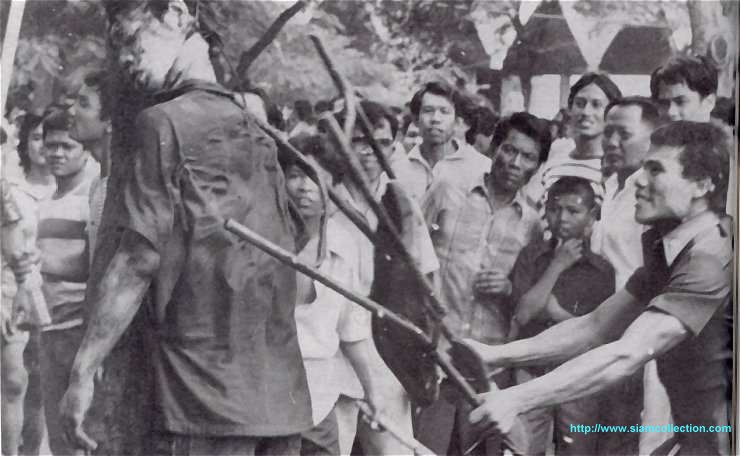
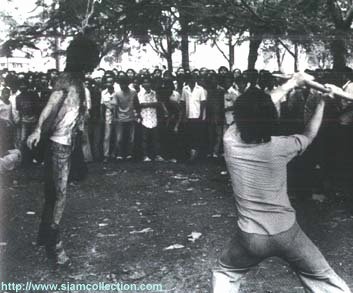
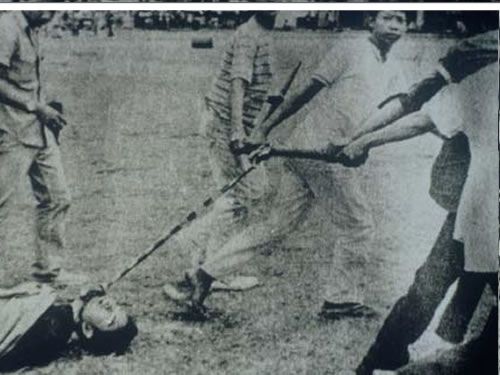
There are three Thai short films that I like very much. They are DON’T FORGET ME (2003, Manutsak Dokmai, A+), RE-PRESENTATION (2007, Chai Chaiyachit, Chisanucha Kongwailap, A+) and “RED” AT LAST (2006, Suchart Sawasdsri, A+). DON’T FORGET ME and “RED” AT LAST deal directly with the Bangkok Massacre in October 1976, while RE-PRESENTATION deals with many topics, including the Bangkok Massacre in October 1976.

After I read some news about Thai current PM’s interview with CNN, I think I love these three Thai short films even much more than before.


This is the news from Bangkok Post’s website:
http://www.bangkokpost.com/News/12Feb2008_news02.php

“Oct 6 people angry at PM's CNN interview


NATTAYA CHETCHOTIROS and PRADIT RUANGDIT


Former student activists who experienced first-hand the brutal crackdown on pro-democracy demonstrators on Oct 6, 1976, have been outraged by Prime Minister Samak Sundaravej's interview with CNN.


During the interview on Saturday, Mr Samak said that on Oct 6, 1976, only one person was killed in the violent crackdown on protesting students and other demonstrators by the authoritarian government of the time.


Apichart Sakdiseth, a Democrat MP for Nakhon Si Thammarat, said Mr Samak had totally distorted the facts about the bloody Oct 6 crackdown.


''In the massacre that took place in the heart of the capital 30 years ago, the official number of people killed was 46 and hundreds of others went missing.


''They're historical facts that people around the world have learned,'' said Mr Apichart.


It was internationally known what led to the Oct 6 bloodshed, who were involved, who the masterminds were and its unprecedented and significant repercussions upon Thai society, he said.


Mr Apichart urged all people involved in the events of Oct 6, including former student activists, academics and relatives of those killed, to come out to defend the facts.


Former student activist Suthachai Yimprasert, now a history lecturer at Chulalongkorn University, said he assumed Mr Samak intentionally gave the wrong information to escape the accusation that he was also responsible for the 1976 massacre of student activists and other protesters.


''I don't want to debate the facts with him. He should know himself that this isn't the first time he has lied,'' said Mr Suthachai.


The history lecturer said there were two major sets of events on Oct 6, 1976.


First, soldiers and police surrounded Thammasat University and killed 46 students, wounded hundreds
others and arrested more than 3,000 people.


Then, in the evening, there was a coup d'etat. All newspaper offices were closed for three days. They resumed publication on Oct 9, and none reported the massacre. Consequently, the casualty figures reported later on were rather confusing.


However, Mr Suthachai said it was not good for a forum to debate the facts about the Oct 6 massacre.


He did not want Mr Samak's incorrect remarks to be the starting point of political conflict.


At least Mr Samak was an elected prime minister, said Mr Suthachai. Academia and the public should give him a chance to run the country as a democracy, he added.


''I still want him to run the country smoothly. But if he is found to be corrupt, then we should come out against him,'' said Mr Surachai.


Jaran Ditapichai, a core member of the pro-Thaksin United Front for Democracy against Dictatorship of Thailand and former Thammasat student who was arrested on Oct 6, 1976, insisted there was clear evidence that more than one person was killed on that day.The prime minister had given incorrect information, he said. ”

----------------------------


I haven’t seen SHOAH (1985, Claude Lanzmann), though the DVD of SHOAH is available in Bangkok. After I read the news about Samak, it reminds me of some people who deny that Holocaust ever happened. I think SHOAH can confirm the truth, can confirm what really happened. I wish there is a Thai director who follows Claude Lanzmann’s example. Maybe we can record the testimony of the survivors of the Bangkok Massacre in October 1976 on video and post some of the clips on Youtube. I know that there are many TV documentaries about this topic, especially the TV documentaries made in 1996 (20 years after the event), 2001 (25 years), and 2006 (30 years). Maybe we can compile these TV documentaries together. Maybe we can made a film in the same style as SHOAH about the Bangkok Massacre in 1976.

http://ecx.images-amazon.com/images/I/51WH2WFXV5L._SS500_.jpg


--Filmsick’s review in Thai on DON’T FORGET ME:
http://filmsick.exteen.com/20071204/entry

--Manutsak Dokmai’s filmography
http://celinejulie.blogspot.com/2007/09/manutsak-dokmais-filmography.html

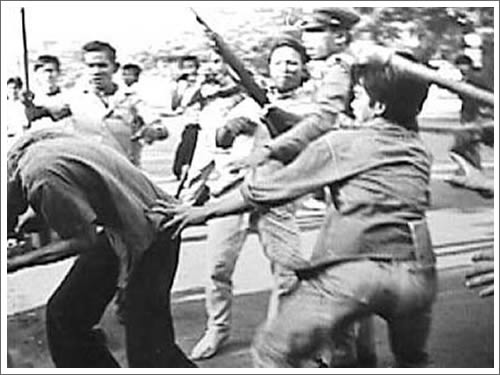
--These are some photos about the Bangkok Massacre in 1976. I copy these photos from MERVEILLESXX’ blog:
http://www.bloggang.com/viewdiary.php?id=merveillesxx&month=10-2007&date=01&group=4&gblog=51

http://farm3.static.flickr.com/2291/2260641810_2858f4ccfd_o.jpg
http://farm3.static.flickr.com/2320/2260641808_a724ceff8d_o.jpg
http://farm3.static.flickr.com/2236/2260641806_a1965eb578_o.jpg
http://farm3.static.flickr.com/2032/2260641804_ddcd4b6fd4_o.jpg
http://farm3.static.flickr.com/2210/2260641802_8dc09ff0a6_o.jpg
http://farm3.static.flickr.com/2066/2260641800_6785a18201_o.jpg


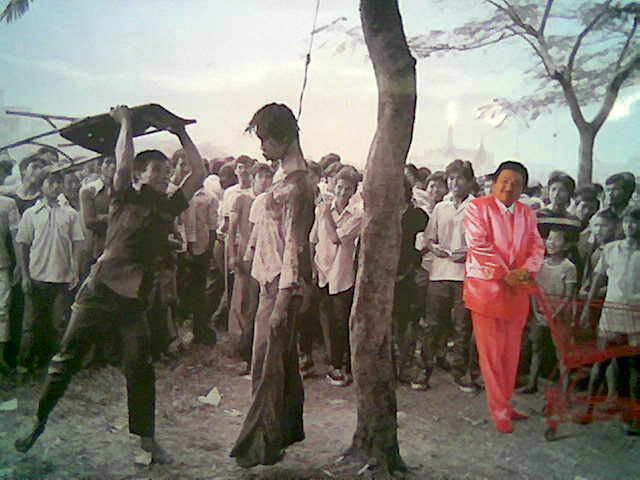
--This is a photo from the photo series HORROR IN PINK (2001) by Manit Sriwanichpoom, which is inspired by the event.
http://farm3.static.flickr.com/2360/1693044709_0b479d6e66_o.jpg


Tuesday, August 28, 2007

FILM AND REAL LIFE 5: THE BANGKOK BOURGEOIS PARTY

--PARTIAL FILMOGRAPHY OF PRAP BOONPAN

1.TWO WORLDS IN ONE WORLD (TAWIPOP NAI EKAPOP) (2004, A+)

2.”POLITICAL” MOVIE (NANG GARNMUANG) (2005, 28 min)

I haven’t seen this film, but the synopsis says that “the film illustrates the meanings of ‘politic’ in Thai society through photographs of historically political events.”

3.THE SPECTRE: 16 YEARS LATER (NANG PHEE: 16 PEE HANG KWAMLANG) (2006, A+)

4.LETTER FROM THE SILENCE (JODMAI JAK KWAMNGIAB) (2006, 5.11 min, A+)

5.THE BANGKOK BOURGEOIS PARTY (KWAM LUKLUN NAI NGAN RUENREANG) (2007, 28.51 min, A+)

(I used to refer to this film as AN INCONVENIENCE IN A HAPPY PARTY)

I don’t know if Prap Boonpan directed other films than these or not. It would be much appreciated if anyone can give more information.

-------------------------------------------------------


--THE BANGKOK BOURGEOIS PARTY talks about many issues, one of which is the fear that there might be a war between the rich and the poor in Thailand.

Recently I just read an article in Prachatai.com which reminds me of THE BANGKOK BOURGEOIS PARTY. The article is an interview with Attachak Sattayanurak, who talks about current class struggles in Thailand.


http://www.prachatai.com/english/news.php?id=159


Interview with Attachak Sattayanurak: The Meaning of Ten Million Votes: “The Poor and Class Consciousness”!

Papan Raksritong25 August 2007
News

The referendum on the draft 2007 constitution was not important just as a ritual to either accept or reject the supreme national charter. There are many hidden meanings in the tense, distorted and manipulative political manoeuvring by the powers that be in the past few months. Despite that, more than ten million voters dared to come out and voice their opposition to the powers that be.


Assoc. Prof. Attachak Sattayanurak from the Department of History, Faculty of Humanities, Chiang Mai University and a member of the Midnight University which has been a major force in the campaign to reject the draft 2007 constitution has this to say about this historic referendum.


Prachatai - What does the result of the referendum tell us?


Attachak - There are many interesting aspects about this referendum. First off, it took place amidst a vehement campaign to promote the endorsement of the draft 2007 constitution. Despite that, ten million people opted to challenge this campaign. It is remarkable how grassroots villagers rose up and I do not think their action could be attributed to the mobilization by the United Front of Democracy against Dictatorship (UDD) or our group (Midnight University).


Our campaign might influence a dozen people in Bangkok, whereas the UDD's campaign might reach a few more, but not all ten million people. In the North, including Chiang Mai and other areas I am familiar with, I heard nothing about allegations of vote buying by the Thai Rak Thai people. We ought to look beyond what the government or the CNS (Council for National Security) imagines. This is not just a matter of pro-Thaksin people.


The two red zones (in which the ‘no' votes were higher) in the North and Northeast are actually the constituencies of the poor whose livelihoods depend on agriculture on the one hand and the informal sector on the other. After 19 September 2006, their two-pronged livelihood has been seriously affected. Just go and ask any of the vendors on the street in Chiang Mai and everyone will tell you that their income has fallen by something in the range of 30-50% after 19 September 2006. As a result, they have vented their frustration and anger (in the referendum). They voted to reject the draft constitution as they felt that the coup and the draft constitution will continue wrecking the economy.


To put it plainly, many of them have not properly read the constitution. What they feel is that the constitution has been backed the army and that will lead political instability. Some may miss the 1997 constitution and as a result voted against the draft 2007 constitution. Nevertheless, this was a class struggle waged by the suffering poor.


It is a fact that our brothers and sisters in the Central Plains, the East or the South are wealthier than those in the North and Northeast. Therefore, if we look beyond the careless thinking put out by the army that their votes were the result of their support for Thaksin, the new government will really have to plan thoroughly on how to tackle income distribution and welfare for the poor. Here the class struggle began, and conflict between the classes will become even more intense.


Class issues are always there and poor people do exist. But now, the poor are starting to become conscious of class issues, and the new government and civil society have to bear this in mind. The middle classes have to learn to understand the poor. Right now, the middle class in Bangkok thinks they are cleverer and use SMS to attack the poor folk on TV.


We have to think anew. Past development has left many poor people to their own devices. Now, these ten million people are yelling "you ought to take care of us, too".


P--All these "red zones" have had unique backgrounds and many of these areas have in the past rejected state authority. Did this play any role in their rejection of the draft constitution?


A--The North and Northeast are significantly different from the South. Of course, Northerners still retain the consciousness of being part of the Lanna Kingdom. But we have been annexed as part of Siam for so long that it is too difficult to resurrect the past. I tend to believe that their rejection of the draft constitution was largely due to their desire to make the agenda of the Northern poor known to the public. There are definitely those in some areas who voted against the draft constitution to show their loyalty to Thaksin, but I think they were the minority.


P--Did incidents from the past play any role in their current decision, such as the abduction of politicians in the Northeast or the Communist smear campaign?


A--There might be some remnant feeling from the cases of Mr. Thong-in Phuripat (Ubon Ratchathani 1906-1949), Mr. Chamlong Daorueang (1910-1949), Mr. Thawin Udon (Roi Et 1909-1949), Mr. Tiang Sirikhan (1909-1952) and Dr. Thongplew Chonlaphum (Samut Sakhon 1912-1949) from the Northeast. Their names still resound, but none from the North. During that time, the Northern MPs were politically less active than MPs in the Northeast including four Northeastern Ministers who were abducted.


In the Northeast, the feeling still remains and there have always been references made to the Phi Bun Uprising during the reign of Rama V, or the cases of the Northeastern MPs or the Communist campaign. But I do not think these historical facts play a more important role than their class consciousness.


P--With this sign of class consciousness, how should the state react?


A--The CNS and the government have to be more cautious and humble. With humility, candidates for the next Senate could be slightly better even though the recruitment structure is inherently weak. For the rest, they have to careful about their role in providing services and control.


One remnant from Thaksin is undeniably the reshaping of state mechanisms to provide extensive services to the villagers and the privatization of control or administration such as the introduction of CEO and marketing systems in place of bureaucratic systems.


This state reengineering cannot be undone. The new government has to live with it and ought to be aware that this state reengineering is not a personal matter of Thaksin or by Abhisit (Democrat Party leader). Don't pretend to say you can do better than Thaksin and that you can provide people with free education. Don't go looking for votes based on false promises. At least, you cannot now reject this legacy of state reengineering by Thaksin, so you simply have to capitalize on it and make it serve the people even better.


P--What should be the next political move?


A--Now that our poor brothers and sisters have voted against the draft constitution, we have to wait and see how the new state, new constitution or new political parties will react, how they will change their role in providing services and control.


To mobilize now is premature and may produce weak results. I have no idea what the thinking is of the student anti-coup group, or the 19 Sept group.


As for the Midnight University, we will keep monitoring the proposed laws related to the constitution, the draft Internal Security Act, etc. I would like to reiterate here that the Midnight University has not played that big a role in triggering the ten million votes.


P--Looking back to the past, coupled with an analysis of the current situation, what do you think will be the long-term changes?


A--If the new coalition, the military and those political factions behind the 2007 constitution, are clever enough and understand the dynamics of Thai society, then after they form a new government, the first thing they must do is to promote public participation. For example, if the villagers submit complaints to the Senate, they have to act promptly in order to minimize class tension. This is my dream. But I am not so hopeful as their previous actions have proven that they are not that clever.


If they do not perform well, their honeymoon period may last just five or six months. And we ought to keep a close watch. After that the conflicts will get heightened until the government or the coalition becomes too weak to do anything. I cannot think of what will happen then. It could be that all the rifts will get entangled across the board, or the villagers will rise up. Or there could be internal conflicts within the military and this may lead to another coup.


Therefore, if we want to contain military power, during the first six months after the election, we have to gradually ostracize their role in politics. We have to push them hard to return to the barracks. But to achieve that, we have to work with greater unity.


Translated by Pipob Udomittipong

Sunday, July 22, 2007

FILM AND REAL LIFE 4: TURISTAS (2007, JOHN STOCKWELL)

THIS IS MY COMMENT IN NEW SCREENOUT WEBBOARD
http://www.xq28.net/wow/viewtopic.php?f=7&t=192&st=0&sk=t&sd=a&start=150

ตอบคุณ SENSITIVEMAN

ไม่แน่ใจเหมือนกันนะคะว่าคุณ SENSITIVEMAN จะชอบ TURISTAS หรือเปล่า แต่ดิฉันคิดว่าหนังเรื่องนี้มันดูสมจริงและเป็นธรรมชาติมากกว่าหนังฆาตกรโรคจิตโดยทั่วไปน่ะค่ะ หนังมันไม่โหดเท่าไหร่ แต่รู้สึกว่าช่วงต้นๆเรื่องมันดูสมจริงดี ดูแล้วนึกถึง WOLF CREEK ที่ดูเป็นธรรมชาติมากๆเหมือนกัน

ช่วงตอนท้ายเรื่องก็ชอบฉากไคลแมกซ์เหมือนกัน ดูแล้วนึกถึง THE DESCENT (2005, Neil Marshall, A+)

อีกปัจจัยนึงที่มีส่วนทำให้ชอบหนังเรื่องนี้ก็คือดูแล้วนึกถึงคดีฆ่าเอาอวัยวะที่ระบาดในภาคอีสานของไทยในช่วงที่ผ่านมา

รูปของ JOSH DUHAMEL ดารานำของ TURISTAS
http://www.exposay.com/8th-annual-michael-douglas-and-friends-golf-tournament/p/3559/1/?f=Josh+Duhamel
http://farm2.static.flickr.com/1009/867374841_e498de8f96_o.jpg

Thursday, July 12, 2007

FILM AND REAL LIFE 3: THAI SILP FACTORY WORKERS

INTERESTING NEWS ABOUT LABOURERS

From Bangkok Post’s website

THAI SILP GOES BACK TO WORK
http://www.bangkokpost.net/breaking_news/breakingnews.php?id=120114

Reading the news about the Thai Silp factory workers reminds me of many films about the struggle of the working class, including many films I would like to see, but haven't had a chance to see them yet. So I decide to write my wish list for these films.

------------------------------------------------------

The following post is related to my earlier posts on

--COUP POUR COUP (A+) and Christian Ziewer
http://celinejulie.blogspot.com/2007/06/favorite-quote-from-coup-pour-coup.html

--Favorite films about working class
http://celinejulie.blogspot.com/2007/07/films-about-working-class.html


This is my wish list for films about the working class

1.A BIENTOT, J’ESPERE (1968, Chris Marker, France)
http://www.imdb.com/title/tt0063854/

Synopsis from imdb.com written by Guy Berlinger:

“1967, one year before may '68. The strike at the Rhodiaceta textile plant in Besancon sounds like the rehearsal of the rising to come. Indeed for the first time ever, the workers' claims are not only higher wages or better working conditions but also BETTER LIVING CONDITIONS. They first and foremost say no to the lifestyle capitalism wants to impose on them. One more year to go and the whole country of France will imitate the strikers of Besancon.”


2.ADALEN ’31 (1969, Bo Widerberg, Sweden)
http://www.imdb.com/title/tt0065261/

Synopsis from imdb.com written by Fredrik Klasson:

“During a strike strike-breakers are being transported to Sandviken, where they are assaulted by the strikers. The military are sent in. On the 14th May 1931 there is a confrontation between demonstrators and the military who open fire and five people are killed and five injured.”


3.THE WORKING CLASS GOES TO HEAVEN (1971, Elio Petrie, Italy)
http://www.imdb.com/title/tt0066919/

Synopsis from imdb.com

“Lulu is a real hard worker. For this reason he is loved by the masters and hated by his own colleagues. The unions decide agitations against the masters. Lulu doesn't agree till he cuts, by accident, one of his own fingers. Now, after he understood the worker's conditions, he agrees the unions and participates to the strike. He immediately is fired and, not only is abandoned by his lover, but also by the other workers. But the fights of the unions allow him under a new legislation to be hired again. At this point his mind starts giving collapse signs...”


4.OCCASIONAL WORK OF A FEMALE SLAVE (1973, Alexander Kluge, West Germany)

This is what Tony Rayns wrote about this film in TIME OUT FILM GUIDE:
http://www.timeout.com/film/reviews/65895/Occasional_Work_of_a_Female_Slave.html

“That rarest of movies: a left wing comedy which doesn't hang itself up in questions of 'realism' but does involve itself very closely with the everyday flux of political and social pressures. Alexandra Kluge (the director's sister) plays a young housewife and mother who works as a part-time abortionist; her cynical complacency gives way to a bright-eyed 'activism' when she's forced out of the job and starts waging a one-woman war against the authorities, the bosses, and the tyranny of the family. Kluge charts her hopeless campaign through documentary (an unblinking look at the fact of abortion) and witty fiction alike, his methods recalling both Brecht and Godard; everything is informed by a kind of wry humour that keeps the plot in perspective without tempering its immediacy. It's hard to think of another film that's as honest, relevant and yet not disillusioned as this.”


5.PAY AND LOVE (1973, Marianne Luedcke + Ingo Kratisch, West Germany)

Apart from being a director, Ingo Kratisch is also a marvelous cinematographer. She is the cinematographer of SOMETHING MORE THAN NIGHT (2003, Daniel Eisenberg, A+). (Daniel Eisenberg is a teacher of Apichatpong Weerasethakul).
http://www.imdb.com/title/tt0356053/


6.TOUCHED IN THE HEAD (1974, Jacques Doillon)
http://www.imdb.com/title/tt0071429/

Synopsis from imdb.com:

“Baker's apprentice Chris is sacked from his job for being late. Unwilling to give up the flat that goes with the job, he and his friends resort to squatting. Liv, a Swedish girl moves in and is soon followed by Leon the car mechanic and Rosette, a girl from the bakery.”


7.THE NIGHTCLEANERS (1975, Marc Karlin + James Scott)
http://www.imdb.com/title/tt0251293/

Synopsis from imdb.com:

“"Night Cleaners" is set in the context of the campaign (1970-1972) to unionize the women who cleaned office blocks at night and were being victimized and underpaid. Intending at the outset to make a campaign film, the Collective was forced to turn to new forms in order to represent the forces at work between the cleaners, the Cleaner's Action Group and the Unions - and the complex nature of the campaign itself.”


8.WOMEN WORKERS OF HARA FACTORY (1976, John Ungpakorn, Thailand)
You can read more about this documentary from the following link:
http://www.adjameson.com/film/bkkiff04.html


9.SO THAT YOU CAN LIVE (1982, Cinema Action, UK)
http://www.screenonline.org.uk/film/id/529374/index.html


10.THE KILLING FLOOR (1985, Bill Duke)
http://www.imdb.com/title/tt0087554/

Synopsis from imdb.com written by Karl Williams:

“During World War I, a poor black Southerner travels north to Chicago to get work in the city's slaughterhouses, where he becomes embroiled in the organized labor movement. He becomes prominent as a leader of fellow African-Americans in the union, though many, including his best friend, view him as a sell-out.”


11.OUR MOTHER IS A HERO (1989, Nikolai Obuhovich, Soviet Union)

Information about this film from the book THE ZERO HOUR: GLASNOST AND SOVIET CINEMA IN TRANSITION by Andrew Horton and Michael Brashinsky:

“Another angle on the same subject, treated earlier in fiction film in Andrzej Wajda’s MAN OF MARBLE, is taken by the Leningrad documentary OUR MOTHER IS A HERO (NASHA MAMA, GEROI, 1989) by Nikolai Obuhovich, which was also banned for several years. In the limelight once again is an ordinary woman who becomes a symbol of an exemplary worker. She starts shopping in special stores and visiting top meetings, but actually stops working. Behind the scene is her family: desolate children, an enervated husband who becomes a housemaid, and a television screen on which, along with falsified Brezhnevian propaganda, we see her, a “hero” of that, not this, reality.”


12.BREAD AND ROSES (2000, Ken Loach)
http://www.imdb.com/title/tt0212826/


13.AN INJURY TO ONE (2002, Travis Wilkerson)
“An experimental documentary exploring the turn-of-century lynching of union organizer Frank Little in Butte, Montana.”
http://www.villagevoice.com/film/0329,halter,45535,20.html


14.WORKINGMAN’S DEATH (2005, Michael Glawogger)
http://www.workingmansdeath.com/


15.MAQUILAPOLIS (2006, Vicky Funari + Sergio de la Torre, Mexico)

Alone Again wrote in Thai about this documentary in the following link:
http://www.bloggang.com/viewdiary.php?id=aloneagain&month=06-2007&date=10&group=11&gblog=1

I haven’t seen MAQUILAPOLIS, but I saw another documentary by Vicky Funari. It’s called LIVE NUDE GIRLS UNITE! (2000, B+), which Funari co-directed with Julia Query. This film is also about female workers, but this time it is about a kind of sexual workers who possess as much dignity as us.
http://www.imdb.com/title/tt0264802/

------------------------------------------------------

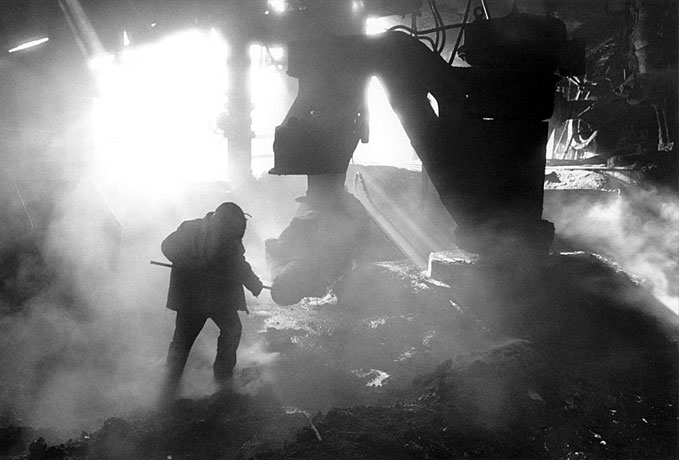
Below are photos from WORKINGMAN’S DEATH


Friday, June 22, 2007

FILM AND REAL LIFE 2: GILES UNGPAKORN

THIS NEWS COMES FROM THE BLOG OF FACT – FREEDOM AGAINST CENSORSHIP THAILAND. I only posted the first paragraph of the news. You can read the full news in the link below.

http://facthai.wordpress.com/2007/06/22/chula-attacks-dr-giles-ji-ungpakorn-over-anti-coup-book/

Chula attacks Dr. Giles Ji Ungpakorn over anti-coup book

Chulalongkorn University authorities are attempting to victimise the anti-military junta academic, Associate Professor Giles Ji Ungpakorn.

Earlier this year Chulalongkorn University authorities ordered the university bookshop to refuse to sell Professor Ungpakorn’s book “A Coup for the Rich”. The book, by the Political Science Professor, criticised the military coup and the destruction of democracy in Thailand. Professor Ungpakorn made repeated attempts to obtain an explanation from the university authorities about why they banned the sale of this book. Up to this day the university has never provided Professor Ungpakorn with any written explanation. The book is, however, on sale at Thammasart University bookshop. This act of censorship, lead to Professor Ungpakorn’s complaint to the National Human Rights Commission that Chulalongkorn authorities had stifled academic freedom. The Commision is currently looking into the case. It should be noted that many of the Chulalongkorn university’s officials, including the Rector and various Faculty Deans and academics are collaborating with the junta and supporting the coup. Academics have been appointed to junta bodies, including the unelected parliament.

-------------------------------------------------------------------------


THIS NEWS INDIRECTLY REMINDS ME OF SOME FILMS, THOUGH THE STORIES OF THESE FILMS MAY HAVE NOTHING SIMILAR TO THE CASE ABOVE. FILMS THAT COME INTO MY MIND AFTER READING THIS NEWS ARE:

1.VERA ROMEYKE IS NOT ACCEPTABLE (Vera Romeyke ist nicht tragbar) (1976, Max Willutzki, West Germany) 104 min

Disagreements over the teaching methods of a politically active teacher end in her being transferred. Starring Rita Engelmann.

(I haven’t seen this film yet, but I like its plot very much.)


2.SLOGANS (2001, Gjergj Xhuvani, Albania)

Synopsis from imdb.com
http://www.imdb.com/title/tt0287708/plotsummary

“Andre starts as a teacher in a remote mountain village in Albania. His first task is to choose one of two communist slogans. He picks the shorter one, which is appreciated by his class, because they have to build the slogan on the hillside using whitewashed rocks. However, this means that the longer slogan goes to Diana, the French teacher to whom Andre is attracted. Andre gets on the wrong side of the communist party boss of the village, when he stands up for an unjustly accused goat herdsman, whom he had befriended. The boss is determined to take his revenge on Andre. Written by Will Gilbert”

(I haven’t seen this film yet, but I like its plot very much.)


3.CALM PREVAILS ALL OVER THE COUNTRY (1975, Peter Lilienthal, West Germany, A+)

Synopsis from
http://www.german-films.de/app/filmarchive/film_view.php?film_id=1283

"The provincial capital of an unidentified South American country. A typewriter mechanic stops at a small hotel run by an old man. He has come to visit his daughter in the nearby prison. A group of young people who recently arrived at the town's airport are just being taken to the prison. Their transport is shrouded in greatest secrecy, but the news quickly leaks out. The young doctor Cecilia and a few friends try to persuade the governor to agree to a medical examination of the prisoners, for they assume that the prisoners were tortured before being charged. However, the governor refuses their request in view of the unstable political situation.

The committee which is then set up collects donations of clothing and food for the prisoners and also visits them regularly. A weapon is smuggled into the prison during a performance in the prison yard. The guards are overpowered, but only a few of the prisoners manage to escape. The others remain behind and demand a medical examination to reveal signs of torture as well as their transfer to another prison not run by the military in return for the release of the guards they hold hostage. The report on the hostages is interrupted by representatives of the army encircling the prison yard. The head of the government imposes a state of emergency and orders the army to take appropriate measures to restore order in the country.

Fear and unrest spread throughout the country following the wave of arrests and the disappearance of members of the opposition. The prisoners holding the guards hostage are shot by snipers, officially while trying to escape, and the funeral procession for one of the victims is dispersed by force. Mass arrests follow and the economy suffers a severe slump. One after another, the hotel's residents are arrested and taken away to a huge football stadium. The old grandfather is the only one to remain behind in the hotel. He packs food and clothes and sets off to the stadium where he insults the guards outside the gate until they arrest him and lead him inside the stadium."


4.SOPHIE SCHOLL – THE FINAL DAYS (2005, Marc Rothemund, A+)


5.THE TRIAL (1993, David Hugh Jones, B)
From Franz Kafka novel, screenplay by Harold Pinter

Synopsis from imdb.com
http://www.imdb.com/title/tt0108388/


“Joseph K. awakes one morning, to find two strange men in his room, telling him he has been arrested. Joseph is not told what he is charged with, and despite being "arrested," is allowed to remain free and go to work. But despite the strange nature of his arrest, Joseph soon learns that his trial, however odd, is very real, and tries desperately to spare himself from the court's judgement. Written by Mike Myers”


I posted FILM AND REAL LIFE 1 in the link below:
http://celinejulie.blogspot.com/2007/06/ye-thamma-2007-wattana-rujirojsakul.html


A photo of GILES UNGPAKORN from http://www.prachatai.com/


Sunday, June 17, 2007

YE THAMMA (2007, WATTANA RUJIROJSAKUL, A+++++)

On Saturday 2, June 2007, I went to see many short films directed by the students of the faculty of communication arts, Chulalongkorn University. This festival is called KANG JOR 14. The festival has been held every year, and this is its fourteenth year. I am very impressed with most of the films.

NAWAPOL THAMRONGRATTANARIT (http://visuallyyours2.exteen.com/ ) and ENNISDELMAR (http://maximomlist.exteen.com/ ) wrote a comment on these short films. You can read their comments in Thai at:

http://film.nitade39.net/board/viewtopic.php?t=104&postdays=0&postorder=asc&start=0


This is the list of the films that I saw in KANG JOR 14 in my preferential order:

NOTE 1: I give the grades according to my own pleasure in viewing the films. So if any director happened to read my comment, please bear in mind that these grades actually mean nothing. The film I like the least in this festival might be a very good film, but I just don’t like romantic films. This is just a comment from an ordinary audience. I usually give A+ to bad movies.

NOTE 2: Most of the films I saw have no official English titles at the moment, so I translate the titles by myself from the Thai titles. These titles might differ from their official English titles in the future. I also transcribe the names and nicknames of the directors by myself, so these names might be spelled differently in other places.

NOTE 3: I apologize in advance if I write anything wrong.


1.YE THAMMA (2007, Wattana Rujirojsakul, A+) 15 min

This film satires many Thai social, religious, and political problems in a very funny way. It is daring. It also seems to condemn the Thai censorship board for the case of SYNDROMES AND A CENTURY. This is a kind of film which I like very much, because it records the political problems of Thailand. This film also reminds of the films directed by Manutsak Dokmai (DON’T FORGET ME) and Prap Boonpan (SPECTRE: 16 YEARS LATER), which also records the problems of Thailand, and in some cases involve a lot of talking. But the main difference is that YE THAMMA is a comedy, while the films by Manutsak Dokmai and Prap Boonpan are a bit more serious. However, I think all these films by Manutsak Dokmai, Prap Boonpan, and Wattana Rujirojsakul might be called ESSAYISTIC FILMS, which is a kind of films which are rare to be found in Thailand.


2.WASABI (2007, Asit Wangsuekul or Q, A+) 30 min


3.GRANDMOTHER (KHUN YAI) (2007, Nawanont Wongkajit or Nont, A+) 4 min


4.FAT GIRL (CONTEMPORARY DANCE FILM) (2007, Chanchana Akajirattikal, A+)


5.GREEN PLANET (KHAJEE POP) (2007, Tanapol Chaowanit or Dew, A+) 15 min

I like the content of this film very much, because it questions some of the practices of the anti-global warming campaign.


6.THE SUCKSEED (2007, Chayanop Boonprakob or Moo, A+) 30 min


7.UGLY IS BEAUTIFUL (2007, Sukhapat Lohwatcharin, A+) 27 min


8.AWAY (2007, Patpimpa Chantranontawongs or Fai, A+) 12 min, black and white


9.JOB APPLICATION (SAMAK NGAN) (2007, Wanwaew Hongwiwat + Waewwan Hongwiwat, A+/A) 20 min

I think the emotion in this film doesn’t run smoothly in some parts, but what I like very much is the heroine of this film. I think she is a very interesting character. She is very much like a normal person who feels insecure about the future, and gets torn between the desire to stand on her own feet or giving her dream up and bowing down to her biased mother. I think this film can be adapted into a feature film focusing on the dramatic life of the heroine, her fear, her hope, her shattered dream, during this turning point in her life.

If the heroine of this film is successful in her job application and her career, I imagine that her life might be like the heroine of JANE (2006, Tania Sng, Singapore, A+), who feels unhappy even if she is materially successful. These two films should make a good double bill.


10.POLICE SERGEANT YEMAR AND THE MURDER MYSTERY CASE 2: LUCKY COOKIE ROBBERY (2007, Thanes Limcharoen or Giaw, A+/A) 20 min


11.HA (2007, Punnawich Tessana, A+/A) 20 min


12.THE ZOMBIE CHICK (2007, Thitimon Mongkolsawasdi, A) 15 min


13.SCHOOL FOR MISTRESSES (BAAN NOI: STABUN PALIT CHOO) (2007, Suchanya Jantrakulasri, A) 20 min


14.IMAGES BEHIND YOUR BACK (PARP KANG LUNG) (2007, Tongtar Wipismakul or Tao, A) 8 min

Nawapol stars in this film. I like his anxious face very much.


15.CAN’T SEE (MONG MAI HEN) ( 2007, Orapim Choenkwansri or Pim, A) 8 min

I agree with Nawapol that I don’t understand this animation, but I still enjoy it.


16.POCKY (2007, Sarawan Weerawat or Joke, A-) 15 min


17.THE DAY I DISAPPEAR (WAN TEE CHAN HAI PAI) (2007, Thitirush Jariyatrakul or Leng, A-) animation, 7 min


18.THE INVISIBLE (2007, Buncha Sritinont, A-)


19.INSANE (FUN FUEN) ( 2007, Venusnun Kanchananukul, A-)
This is a music video.


20.LET GO (PLOI) (2007, Pimpimol Banlutangtam or Jib, A-/B+) 20 min

I like the first half of this film very much. I give A+ to the first half of this film. And I agree with Nawapol that the first half of this film is like a romantic dream of a woman.


21.TWIST LOVE BUS TICKET (TUA RUK PLIK LOCK) (2007, Kriangkrai Wachirathammaporn or Ping, B+) 20 min


FILM AND REAL LIFE 1

GREEN PLANET (KHAJEE POP) reminds me of many pieces of news I read, such as:

--The switching from petroleum to palm oil causes much deforestation, and many animals in Indonesia have been brutally killed in order to clear the forest to make palm plantation.

--Some farmers in cold countries turn to plant tropical plants, so that they can cut down the petroleum used in transporting this food from tropical countries. But they end up using much energy in heating the place where they plant tropical fruit or vegetable.

--IKEA supports the idea of using woods from plantation forest, not from indigenous forest, but some people comment that IKEA furniture are so trendy that the consumers tend to buy new ones every five year, instead of using the furniture for a long period.


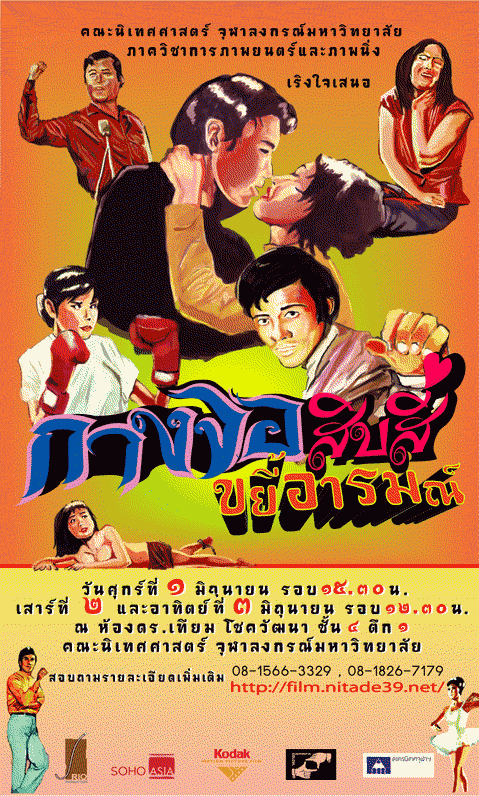
A POSTER OF KANG JOR 14